

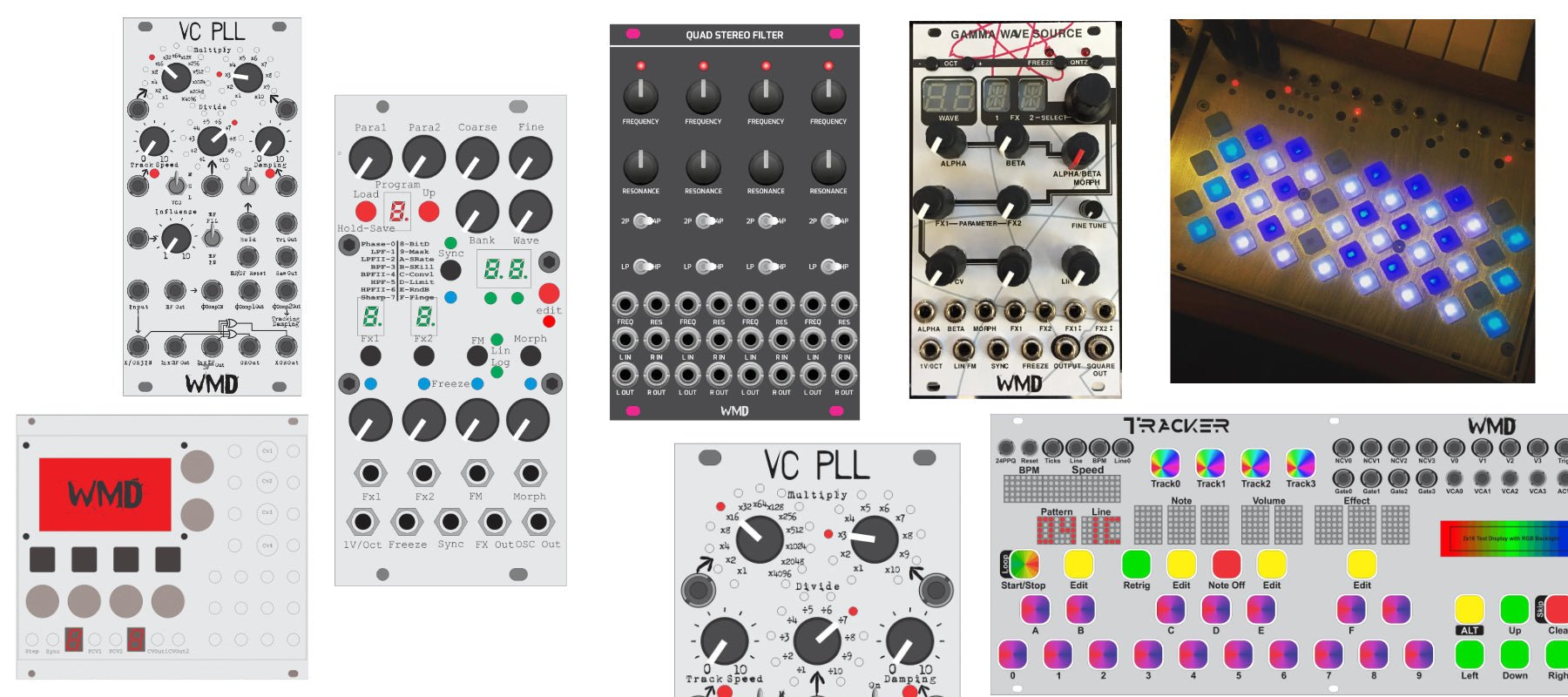
Over the last 19 years I've started a lot of projects, not all of them get finished, usually for good reasons. I'm going to go through memory lane here, and the box of broken dreams (what's left that hasn't been salvaged or recycled) for a blog post about the past.
Digitally Controlled Analog Tube Simulator Pedal (2009)
This was my project immediately after getting the original Geiger Counter into production, circa 2009. This design was a fully digitally control analog distortion. The preamps were a couple different types, a JFET high gain, and a silicon BJT medium gain. Selectable via switches, and with their own level controls. That then drove a 4 band parametric EQ.
There was never a full design, just the PCBA to sit on my desk and develop on. I did several prototypes of this, and learned about a few things along the way that influenced some things to come.

The first thing that came directly from this design was the LMF100 chip -- this now obsolete filter IC would be the heart of the Synchrodyne. In this design, the MCU drove the clock pins directly with a clock, setting the four filters cutoffs. There was a fair bit of aliasing and intermodulation distortion produced though in the filters, which didn't work well for a guitar processor. But this proof of concept lead me to designing the Synchrodyne around this part to explore how an analog clock would sound.
The next thing that came from this was the Parametric EQ architecture I'd use in both the Acoustic Trauma and the Utility Parametric EQ. Though both would use simpler filters that were not voltage controlled. Parametric EQs weren't particularly popular in guitar land in 2009, but it would be a few years before mine would come out.
The Acoustic Trauma also got its dual cascading preamp stages from this early design, conceptually. There was a lot of voicing that went into making the AT preamps sound really great. The switching was eliminated, but the topology stayed the same.
I also developed a strong liking of digital potentiometers, especially the Analog Devices ones, used here for digital control of analog where resolution and smoothness wasn't super important: gains, resonance, tone controls. These Digi Pots would be used in a number of WMD products: Digital VCA, Geiger Counter Pro, TRSHMSTR (the tone control), and I think the WMDSSF Mini Slew too.
I don't think I have an image or the hardware for this thing any more. It was just a PCB with jacks for guitar hanging off of it, a couple encoders and a text screen for doing the sound design. It would've made a terrible product as it was, but it lead to a lot of great discoveries that would shape my interests for years to come.

This is an image of the PCB from ExpressPCB, awful design, I'm surprised anything worked with that program. No error checking, no verification, but boards would get delivered in about a week, which was pretty impressive for 2009. And here is the assembly code for the project for fun...
Voltage Controlled Phase Locked Loop (VC PLL, 2012)
I posted about this one on Muffwiggler (now Mod Wiggler), after releasing Synchrodyne. The concept was to take the PLL section, and make it fully voltage controllable. The PLL of Synchrodyne is a huge part of its sound.
The problem -- The PLL was really only stable at higher frequencies, so with the Synchrodyne's 50:1 or 100:1 cutoff, it worked great, but as an audio source directly, it was terribly unstable at lower frequencies.

This one got its panel and schematic. It was going to use an Atmel XMEGA processor, coded in assembly to control the switching from 3x ADC inputs, a big development time sink. The layout would've been pretty complex for the time too, and needed a dual board design. The real killer, was using these floating OTA resistors that were untested, and very unlikely to work. The Synchrodyne Expand used some of this circuitry, without the MCU, and the OTAs never worked right, and I had to use Vactrols to add voltage control.

Overall, I'm not sure this would be a great product, it's pretty niche, and there were simpler VC PLLs out already from Doepfer that give you the PLL sound. I'm glad I killed this one as I think it would've been a single-trick piece.
VC Morphing Filter (2011)
This started in 2011, the concept is a 4 channel analog morphing parametric EQ / resonator. It had a screen to show the EQ curve, soft knobs and tactile switches, with a couple rotary encoders. The UI looked good. It had direct outs for the filters and some CV for morphing through presets and assignable realtime control. Had it gotten done, it would've been a great product probably, especially in 2012.
It used state variable filters sections, peaking bandpass for mid bands, and bandpass or shelving for low/high bands. The design used digital pots for the cut/boost on the EQ. But I was hoping to save money by using PWM to do the frequency control which never would've worked well, too laggy or too noisy. This pulled from the parametric EQ above, but made new problems that would never be solved!

Getting the filters to sound good would have been really tricky as well, these filters are similar to the Micro Hadron Collider, and they aren't stable when clipping. They don't self oscillate nicely. There would've been noise issues with the OTAs anyway.
The original design had a XMEGA with lots of I/O for controlling the filters, and a second XMEGA for the display and UI. Extra code, processor to processor communication, it was all unnecessary. But this was an early fully digitally controlled analog design.

I did a layout and ordered circuit boards for this thing but realized it had lots of issues before building one up, so it was abandoned.
Eventually, we came out with SCLPL, which contained most of the concept, but used digital filters and a much smaller UI and in stereo, without all the unnecessary bits.
Quad Stereo Filter (2022)
More recently, We were all using Assimil8or in our performance cases, and thought more filtering would be tremendous for a sampling heavy modular system. So we thought about a multi unit filter, it needed to be compact so it could replace the multiple Overseers in our rigs to do simple filtering duties.
It started as a triple filter, but we opened it up to a quad.

We built the design around the SSI2140, which is LP only. And I thought we could do a HP version with phase inversion injection of the fundamental, which worked technically, but rather poorly. The amount of dry signal cancelled changed based on resonance, so it was passable in some settings, but useless in others. Using a cascading state variable would've been better, but we wanted to try something different.

We built a couple revisions of prototypes and then canned the project. It also doesn't really fit with our other products in a cohesive way, so I think it would have been a confusing offering.

Schematic available for educational purposes above.
Tracker Sequencer (2013)
I started my electronic musical career around 1995, age 11. And I enjoyed the music coming out of the UK, Germany, and notably Finland -- the demoscene, huge in Scandinavia. I found this love for trackers, video game music, and electronic music that I could dig into and see how it was made. During middle school and high school I made a massive number of tracks in FastTracker II. And I wanted to bring that into the modular world.
The gist -- a four channel "tracker" with CV / Gate outputs for the 4 tracks, and then 4 additional triggers for drums. Line by line editing, or a nice UI for note entry, SH101 style. The buttons were LED backlit silicone pads, some multicolor, some RGB. I wanted to have the tracker style effects available too, portamento, trills, etc.

This project was at the bleeding edge of my capabilities in 2013, and was beyond me for coding. I had talks with a few software engineers, but nothing transpired, the project was a huge undertaking. I also realized that the project wouldn't work without a monitor or bigger screen, and I think TFT was available, but OLED was not yet. I also designed this around an XMEGA rather an an STM32, so the MCU would have had a tough time doing everything necessary to make a good sequencer.
I did make hardware for this, but I don't think we built it to a panel, I had the boards laying around for a long time, but never powered them on.
This certainly influenced Metron a bit, the jacks on top, minimal screen concept. Ultimately I'm glad I didn't put more effort into this, I think that the trackers that did come out are far superior (NerdSeq, and Polyend's Tracker).
Isomorphic Keyboard & Sequencer in Eurorack (2014)
This is a 4 channel polyphonic aftertouch keyboard that was really fun to play. Pitch CV + Pressure CV + Gate per channel, you could play on several different programmed scales, and it felt great under the fingers, the buttons were squishy and very easy to get a nice pressure gradient.

I had plans to add sequencing and some other features, but found a major flaw with the design that made it tough to continue.
The buttons relied on relied on rough surface texture distributed across the contact area, and used HASL for the finish. Different buttons had different gradients because of the finish being unevenly distributed. And it wouldn't work at all with ENIG, just on or off, because there was too much surface area touching. So we could do some kind of calibration, or a mega complex stackup of conductive fabric, which i tried and didn't like. So we scrapped the project.

This is the performance case for it, 4 voice polyphonic WMD/SSF line. It was a little tedious to tune, but was a ton of fun to play. The module in the bottom right was a granular digital tapehead module, again built on an Xmega + external RAM, I put a lot of evenings into it, but it never got fleshed out fully. It made some really great sounds using variable sample rate direct ADC/DAC to memory with multiple playheads.
The isomorphic keyboard was fun, and really pretty, but at the time there were not many polyphonic synth options in eurorack so building a system out to use it would require redundancy and be insanely costly and complicated. Then Roger Linn released Linnstrument, which was a great implementation of a similar concept, so I lost interest in continuing development.
Gamma Wave Source MKII (2019)
The original GWS (2010) was a great sounding module with a number of really important flaws. So I wanted to improve and re-release it. It was quantized, and had poor CV handling that was inherently nonlinear. I take for granted how much I've learned about signal conditioning for ADCs since then.

The prototypes took on multiple versions over the years. Many digital and not hardware, and a few that did become hardware. Trying to squeeze too much into a space was an early lesson to learn. Smallness isn't necessarily fun to play.
This unit was a single oscillator with cascading effects, and more overall control over the sound. It was still a variable sample rate oscillator, so you'd get lots of aliasing but it would be timbrally constant as the pitch changed, really beautiful sounding.

We got this hardware going, and I played a couple Freq Boutiques with this unit, but there were features that were truly beyond the scope what the Atmel XMEGA processor could handle, and some very difficult to find bugs, so I killed the whole project. I still love the sound and hope to have another go at it someday.
What I've Learned
This has been fun to look back see all the ideas that didn't stick to the proverbial wall. Every throw has taught me something and made all the good ideas better.
- Making failures is part of the design process, I will continue to try things and pursue them to their conclusion; for the love of the design process.
- I have learned to put more work into choosing the best seed to grow rather than watering everything with the limited time I have. (...why I killed the contract manufacturing side of WMD).
- Knowing when to quit on an idea frees one up to work on the next better thing.
Thank you for supporting WMD, my creativity throughout the years, and for sharing the music you've made with my artistic tools!
-William Mathewson
Share:
Skorpion's Block Diagram, and a rant about Potentiometers.
Triple Bipolar VCA Crossfade Mod